Saturday, November 3, 2012

Among other things: why I am firmly pro-choice, and why evangelizing by intimidation infuriates me

Okay, so a little background: a friend on Facebook from SPU shared this image on her feed:

And I pointed out the ways in which this picture was misleading, mainly that I consider embryos and fetuses life, just not necessarily people, and that we certainly don't have issues killing bacteria here on earth.

That led to some discussion that, for being on Facebook, was surprisingly civil, that resulted in her advocating for adoption as an option, and then recommending I watch this video (Direct YouTube, in case the site changes). Now, I don't recommend you watch this video. It was infuriating, and is half an hour of a guy (ironically named Ron Comfort) bullying people into agreeing with him. He uses the oft-used "ask leading, scary, intimidating questions that frame the discussion such that when I go in for the kill you have forgotten why you believe what you believe and look like a terrible person if you disagree with me even though you're not" technique, and it's frustrating and repugnant to watch person after person be subjected to it. But the basics: the first 13 minutes remind us of how horrible the holocaust and Hitler were, and includes a disturbing but carefully-selected set of clips of people having no clue who Hitler was. Halfway through we finally get to abortion, and he does the usual of comparing abortion to the holocaust, and corners people into agreeing that abortion is unequivocally murder. In particular, he uses this pre-example of if you were in a bulldozer, and Nazis were telling you to bury some Jews, most of whom but not all of whom were dead. If you don't, you get shot, Nazi gets in and does it anyway. He then takes it one step further, asking that if the Nazi instead gave you the gun and told you to shoot the survivors (actually a more merciful option than live burial), would you do that? The answers varied, but were pretty mixed on the first question, and heavily weighed towards non-cooperation on the second.

After sitting through that for a half-hour, there were a lot of things in my head, but what I ended up writing down was a pretty lucid, I think well-thought-out explanation of why I so vehemently abhorred the video, and more generally, why I am pro-choice. So I decided that all that thinking and writing should find its way out of that particular Facebook thread, and onto this blog. So, with minor editing for context and cleanup, here was my response.

I have so many issues with what this ironically-named Ray Comfort is doing, and think what he is doing is morally heinous. But what he did do is highlight for me what the root problem that I have with legally prohibiting abortion is.

The example Ray was giving at the beginning - with the tank and the gun - is a morally unsolvable question. There is no moral right answer to that question. If the Jews are going to die anyway, and you have a choice between burying them yourself, or dying and letting the Nazis bury them? There is simply no right answer to that question. Either option is terrible, and morally repugnant, and a horribly traumatic experience. But if someone chose to exit with their life and carry that choice with them for the rest of their lives - would you sentence them to death? Would you stand behind them and mandate that they submit to death, because you think they shouldn't bury the Jews?

I certainly hope not. Because as I stated: there simply is no morally correct thing to do in that situation. Those kinds of situations exist. As much as we don't want them to, they exist. It would be so nice if every situation to had a nice, clean, right-or-wrong, black-or-white answer so that we can tell other people when they're doing the right thing or not, and we could know whether we are doing the right thing or not.

But the world isn't always like that. And presenting people with a situation like that - where there is no moral right answer, where every option is horrifying and morally repugnant - and then pressing them to answer, pressing them to make a decision, and making it clear that if they make a decision that you think is the less evil of the two, then they are wrong and morally lacking and bad people - that is evil. It is wrong, it is cruel, and it is evil.

To bring this back around to the topic of abortion: I believe that abortion is another of these situations. An unwanted pregnancy is a morally heavy situation. There is no one right answer to what to do when faced with an unwanted pregnancy, especially when there are severe consequences to carrying the pregnancy through. There is no clear, shining, white, correct answer. There is no choice you can make that is not messy and difficult and distressing.

For me to go in, with legislation, and decide (especially as a male who will never be pregnant!) that for everyone, my choice is the correct choice - in this situation where there are no clear right answers - is morally repugnant, and I simply cannot do that. If you find yourself in that situation, by all means carry the baby to term and give it up for adoption. But don't force everyone else to do so, just because that is what you have wrestled out of this insanely difficult, no-right-answer situation.

In summary: Like the tank example, an unwanted pregnancy is a complex, morally heavy, very difficult situation, with no one right answer. There is no one morally right answer to it, and forcing one answer on everyone is morally repugnant.

Now, I also had significant and independent issues with the video itself and how it was filmed, its arguments, and particularly with how Ron Comfort treats people. The comparison of abortion to the holocaust is a common one, because the holocaust is the example of ultimate evil in the world, so most things people see as evil eventually get compared to Hilter and the holocaust. But there is a world of difference between killing people, with lives and children and mental activity and birth certificates and consciousness, and killing an embryo that has no appreciable mental activity, no consciousness, no sense of self. Taking an ultimate evil and aligning people's actions with it is deceptive and does not result in useful change.

As an example, consider this: octopuses are very complex creatures with consciousness, some basic sense of self, they have families and brains and beating hearts, they care for their eggs, and show signs of incredible intelligence and problem-solving skills. But our society has accepted that it's okay to kill them because they taste good. Would you kill a person if they tasted good? Why is it okay to kill octopuses? Is it because they can't talk to us, can't communicate? Because they are different from us? Does that mean it's okay to kill mute people, or people with severe mental disabilities, because they can't communicate as well? Does it mean it's okay to kill people of other races because they're different than us? No. No rational person would answer those questions affirmatively. You could probably find some off-the-wall neo-nazi who will give you repulsive quotes about how he would kill those people, for effect, if you wanted. But the majority will say no. Am I okay to conclude, then, that those who kill and eat octopuses are evil, that calamari is the new holocaust, that we should immediately outlaw the killing of octopuses? If you're willing to do that, what about pigs? They are also surprisingly intelligent creatures. Cows?

In the case that you are a vegetarian, and you do think that killing animals is morally repugnant - do you think we should make it illegal to kill animals in all situations? Outlaw meat entirely? If not, why not? You just agreed that it's morally wrong, why should we not outlaw it?

You may think that what I am doing is unfair, or full of logical fallacies, or beside the point, or painting you into a corner, or just a bunch of distracting, question-firing, I'm-smarter-than-you bluster.

That's because that's exactly what it is. If you step back from my rapid-fire questions, my cornering you with carefully selected questions, you realize that there are reasons that as a society we think it's okay to eat animals. Most people - at the least - aren't advocating for outlawing pork, and that is a good thing. Because there is a difference between killing octopuses and killing people, even if my questions made it seem like there wasn't.

And that's exactly what Ron Comfort is doing. It's ruthlessly effective, but it's bullying, it's unfair, and in my opinion, is an evil, very morally problematic thing to do. And it does nothing, in the end, to further your point, except to bully and intimidate people to agree with you, at least while you have a microphone shoved in your face, but it does nothing to foster discussion or change hearts and minds.

Another minor counterpoint: Ron is arguing that fetuses are people, which is not a universally acknowledged or agreed-upon point. But for the sake of this argument, I will pretend that's a given. He then gets people to say that they value life, that they wouldn't shoot the Jews, and then asks them why they would kill babies, isn't that the exact same thing? And because he's bullied them with his questions and framed the conversation very specifically, they can't find a way out.

Killing is bad, but killing isn't killing isn't killing - even if it is undeniably human. There's a reason we have trials and varying punishments, and don't just hand out the death penalty every time someone causes the death of another person. There's a reason we have manslaughter, and first-degree murder, and second-degree murder. It's because even murder - that universally bad thing - is not black and white. It's not simply all right or all wrong. If I fail to secure something in my truck and it ends in the death of someone, I undeniably caused their death. Should I get the electric chair? No. There should be some punishment, but few people will argue that I deserve to die. Did Ted Bundy deserve to die (or spend life in prison)? Most people will agree with an emphatic yes. If I kill someone because I thought they were going to kill me, but I ended up being wrong, should I die or have life in prison? Probably not. Should I spend more time in jail than if something fell out of my truck? Probably.

And most saliently, in my opinion: why is it morally acceptable to wage war and kill hundreds of thousands of innocent civilians? Why is that killing okay? You probably have all kinds of reasons, and a lot of them are probably good ones. You have justifications, and that's a good thing. I may not agree with them all - I personally have never seen a wholly satisfying justification for war - but you probably have reasonable justifications.

What does this all have to do with abortion? Because even if abortion is killing a human life - which I don't believe that it is - you can't just say that it is wrong at its face because of that. As a society, we have several justifiable reasons to kill someone. It is striking when put that way, but it's very true. So you have to offer some additional argument - besides "it is killing someone" - to justify outlawing it. And again, this is even if an embryo is a full-fledged person with rights. When you start offering those reasons, there we can hash back and forth why we believe the different things that we do, but simply saying "it's killing, you said killing was wrong, therefore you contradict yourself" is facile, frankly lacking in thought, and not at all useful. Taking that reasoning to make laws and intimidate people into agreeing with you is wrong, and watching that kind of bullying happen for half an hour straight was incredibly frustrating and discouraging.

Wednesday, August 1, 2012

Chick-Fil-A: It's about Jesus

This morning, I came across an article posted on Facebook by one of my relatives entitled "Why the Chick-Fil-A Boycott is Really about Jesus". Said relative (like half my family) lives in Kentucky, and is therefore in the midst of this whole Chick-Fil-A kerfuffle. As a resident of Portland, Oregon, I on the other hand am 300 miles from the nearest Chick-Fil-A, so I've been largely staying out of this whole mess. But when I saw the above article title, I had hoped that perhaps it was some progressive Christian that had written a good article about how Jesus didn't care about the gender of your life partner, and was more concerned about excluding people and making outcasts of people, and therefore would be appalled by Chick-Fil-A's loud stance in His name and their support of so many organizations that actively oppress others.

But, alas, that was not the case.  Instead, the article asserted that this wasn't about Chick-Fil-A's consistent opposition to homosexuality.  No, this boycott was actually about the fact that Chick-Fil-A is Christian, and believes in Jesus:

As weary as we may be of the culture wars, the Chick-fil-A controversy is a harbinger of further ostracism to come. In the United States, the words of Jesus are coming to pass for those who hold tightly to His vision of sexuality: You will be hated because of Me.

This is dangerously close to the mistake many Christians make: extrapolating Jesus' words into if you are hated it is because you are doing my will.  Which is, when actually stated, preposterous, of course.  But when you hold up Jesus' phrase as evidence that you are doing His will, you're pretty dangerously close to stating exactly that.

And here's the thing: I've read every recorded word that Jesus ever spoke on this earth, many times.  And I can tell you this, and any honest pastor, scholar, or Christian should be able to tell you this: Jesus said nothing about homosexuality.  And he said very little about sexuality.  In fact, in a summary that jibes with my recollection, exactly four things.  And all of those things center around one thing: be faithful to your wife.  Don't get divorced, except maybe in the case of adultery.  And even if you are an adulterer: humans don't really have the right to condemn you, and neither does Jesus, but please - go and sin no more.

That's it.  That's all Jesus said about sexuality.  As far as we have recorded, there is absolutely nothing that Jesus said that could be remotely construed as having anything to say about homosexuality.  Opponents of homosexuality never pull out anything Jesus said, because there's nothing there that is helpful.  It's all Paul and Leviticus, because that's about all there is.

And there's another thing.  Chick-Fil-A has hardly been quiet about its Christian principles and founding.  They've been adamantly closed on Sundays for as long as they've existed.  It's a point of pride for them, it's their trademark, their thing.  And have liberals risen up in distress and anger, calling foul, organizing boycotts, because they're not open on Sunday?  If we have, I didn't get the memo.  And the thing is: there has been no such uprise, because the issue we have with Chick-Fil-A isn't that they're Christians.  I have no problem with Chick-Fil-A not being open on Sundays, even though that is a pointedly and necessarily Christian thing to do.  If this was a case of "Christophobia", shouldn't there be an uproar about this brazen and in-your-face proclamation of Christ's resurrection?  Shouldn't governors be up in arms because this establishment dares to stand up for its beliefs and not operate on a perfectly good operating day?

But there hasn't been.  Because I - and most liberals, I think - have no problem with Christians in and of themselves.  There are many Christians I respect deeply and agree with wholeheartedly.  The reason I oppose Chick-Fil-A is not because they're Christian.  It's because they are vocally and proudly in opposition to homosexuality.  And that is exactly why this boycott is happening, and why there is an uproar.  To assert otherwise is deceptive and ignoring the facts.  The article in question has this to say about the subject:

When the mayors of prominent U.S. cities in the north and west told Chick-fil-A they would not be welcome there, they were making a statement that goes beyond one’s position on gay rights. These remarks were an example of social ostracism – not just toward those who hold to traditional views on marriage but especially Christians who hold these views and seek to practice their religion accordingly.
Now, let's look at the statement that started all this, that from the mayor of Boston:

You called supporters of gay marriage "prideful.'' Here in Boston, to borrow your own words, we are "guilty as charged.'' We are indeed full of pride for our support of same sex marriage and our work to expand freedom to all people. We are proud that our state and our city have led the way for the country on equal marriage rights.

I was angry to learn on the heels of your prejudiced statements about your search for a site to locate in Boston. There is no place for discrimination on Boston's Freedom Trail and no place for your company alongside it. When Massachusetts became the first state in the country to recognize equal marriage rights, I personally stood on City Hall Plaza to greet same sex couples coming here to be married. It would be an insult to them and to our city's long history of expanding freedom to have a Chick-fil-A across the street from that spot.

That short statement packs in the phrases "same sex marriage", "equal marriage rights" (twice), "discrimination", and "same sex couples", but not once does it mention Chick-Fil-A's Christian affiliation.  Go ahead and read the whole letter.  You'll find more references to same sex marriage, and once again, absolutely no reference whatsoever to Chick-Fil-A's religious afilliation.  Some may say that Thomas M. Menino is being sneaky and trying to attack Christianity without mentioning it, but I find it a whole lot easier to believe that what he has an issue with is exactly what he says he has an issue with: vocal opposition to something that his city and state have been on the forefront of promoting: marriage equality*.

The article also tries to brush aside Dan Cathy's opposition to homosexuality, saying "In context, it appears he was speaking primarily about divorce."  They also complain that his statements got him "suddenly labeled 'homophobic' and 'anti-gay'." Firstly, the thing that most people are boycotting is Chick-Fil-A's history of generous corporate donations to groups fighting against homosexuality.  Chick-Fil-A has been labeled as anti-gay for a long, long time.   Dan Cathy's recent statements are just a flashpoint that brought the company's views more into the public eye.  Secondly, the divorce claim is a rather weak attempt at distracting from the actual issue.  The assertion that Dan Cathy would make such a statement solely to speak out about divorce is a bit of a stretch.  Public Christian figures don't speak out against the evils of legalized divorce, and they don't campaign to outlaw divorce.  The "traditional family" is used relentlessly to mean heterosexual families, and is never used in the non-existent divorce debate.  That's not to say that Christians aren't opposed to divorce - most are, at least in principle.  But divorce is never cited as an agenda that is trying to take down Christianity.  If Dan Cathy was actually speaking out about divorce, he would have made it very clear, if only because it's not a topic of public discussion.  Homosexuality, on the other hand, is, and the assumption is that he is addressing issues of public discussion.

The article also at this point claims that he is supporting a family model "that has been the norm for thousands of years."  I'm not going to spend much breath countering this statement that any historian - or again, any honest Christian - can tell you is patently false.  But unless you want your model of marriage to include wives as property, extramarital affairs as standard practice, marriages as a method of social climbing, polygamy, and recreational gay sex as an accepted norm - and that's just in the Western world - then I'd be a little more cautious about claiming the last few thousand years to your tradition.

The article also claims as evidence of its Christophobia a hypothetical Muslim business that declaimed homosexuality.  Would they receive the same backlash?  I like to think they would, the article doesn't think so.  The problem is, we have no way of knowing, because there are very few businesses that are publicly Muslim.  This is probably because Muslims are often feared and characterized as a bunch of terrorists and extremists, so I doubt that a publicly and vocally Muslim business would do very well.  There's also the factor that, despite claims of persecution and Christophobia, 78.4% of Americans are Christians.  The fact that 0.6% of Americans are Muslim also goes a long way to explain why there isn't a nationwide chain that proclaims its Muslim values.  But let's pretend that this hypothetical Muslim business did exist and thrive, happily and without controversy closing five times a day for prayer, for years.  I would be glad for them.  And then say they made an open statement against homosexuality.  I would like to think that there would be a similar uproar.  If there weren't, however, I don't think it would be because we harbor this Christophobia but not an Islamophobia.  I think it would be, in fact, precisely because we are trying to avoid being cast as anti-Muslim and Islamophobes, even though our actual issue is their stance on homosexuality.  I can see that happening.  But in the end, it's a hypothetical anyway.  It is useless to wax about what reactions would and wouldn't be to prove a point, because no one knows what the reactions actually would be.  You could argue that we should have a similar aversion to seeming anti-Christian and Christophobe, but I would simply point back up at the percentages - 0.6% versus 78.4%.  Christians are far from a minority that can be categorized and excluded from society, and that makes all the difference.

In fact, here's another wrench in the argument this article makes: you know us liberals and boycotters that are protesting Chick-Fil-A, supposedly because they are Christophobes?  There are Christians among us.  A lot of them.  In fact, less than half of Christians even identify as conservative.  Of the hundreds of millions of people in this country that love and worship Jesus Christ, less than half of them think homosexuality should even be discouraged.  And there is a huge portion of those protesting Chick-Fil-A that are part of your ranks as Christians.  The problem those protesting have with Christians is when they use their money, their status, and their platform to oppress other people.  People that we care about.  It's when the owner of Chick-Fil-A stands up and says that he supports the "traditional family" and "Christian principles", by which he mans that he doesn't think two men should be able to get married.  In fact, progressive Christians - and there are a lot of them - are often even more incensed by his statements, because he is claiming to speak for their God, for their Christ.  I don't claim to be a Christian, but I know many of the more progressive variety.  And Dan Cathy is using the Jesus Christ that they know and love to advocate for oppression and exclusion - and that doesn't honor the Christ they know.  It's antithetical to the Christ they know.  And that is why, for them, this debate really is all about Jesus: because the Jesus they know would be saddened and dismayed at Dan Cathy's statements.

*That said, a disclaimer: I believe that Boston's mayor is overreaching is bounds here.  It's one thing to fight for marriage equality via legislation, and quite another to discriminate against companies based on the views of its founder.  And in a statement that for some reason I hadn't heard about yet, NYC Mayor Michael Bloomberg - hardly a paragon of conservatism - agrees with me, saying it was inappropriate "to look at somebody's political views and decide whether or not they can live in the city, or operate a business in the city, or work for somebody in the city."  He expanded on that, saying "trampling on the freedom to marry whoever you want is exactly the same as trampling on your freedom to open a store."  Well put, mayor.  Citizens like you and I are perfectly entitled to boycott, protest, and support whoever we want, but when it comes to government entities trying to use their legal powers, that crosses a line.  One other note: as a private entity, however, Jim Henson's company is perfectly within its rights to sever business ties with other private entities that go against what they stand for as a company, and I applaud them for doing so.

As another small point of agreement: the article declaims the widespread use of "homophobia" for anything opposing gay marriage.  I, too, tend to think that the word is overused and used as a broad brush.  These are complicated issues, and most of the opposition is not borne out of conscious hatred, but out of an allegiance to values of their faith.  I firmly believe that this allegiance is misplaced and unnecessary - even antithetical - but it's the allegiance nonetheless.

All statistics quoted are from the Pew Forum on Religion.  Some of the numbers required a little calculation to get the totals I quoted, and those calculations are in a Google Spreadsheet.

Monday, June 11, 2012

An open letter to the non-allies in my life

Again, my posts are few and far between. But this one opens with an image!

Today I wanted to re-post this Colbert quote on Facebook (with some commentary):

But I didn't, for the same reason I don't post much potentially controversial stuff to Facebook. I feared that regardless of what commentary I added, it would be taken as simply an attack or a dismissal, and ignored. What I actually want is to gently prod and perhaps give an opening for discussion to those for whom it is most relevant. And yes, that's mainly you, Mom and Dad, but to varying degrees my brothers, college friends, and people from my hometown. So I remembered that I had this blog, and decided that it would be an excellent medium for further commentary, since it's longer-form, and is more of a read-at-will thing and less in-your-face than just a Facebook post.

So for starters, the quote in text form, since image macros are kind of obnoxious. Steven Colbert to Neil Patrick Harris, openly gay actor/singer/dancer with a husband and two adorable kids:

You are also the biggest threat of all: you're a gay person I like. Your threat is that you make being gay not seem threatening. It's almost as if your happiness does not take my happiness away.
The reason this quote was so striking to me is that it very closely resembles remarks that I have personally heard on multiple occasions. There are two specifically that come to mind. One is the general unhappiness about Glee featuring gay characters, which I wrote about (in a less discussable and more exasperated form) two years ago.

But more pointedly, it reminds me of what my parents told me when I was planning on living in an apartment with Aaron, a gay floormate, my junior year of college. I distinctly remember being told (hedged and perhaps hesitantly, but clearly) that living with a gay person would cloud my judgement, that it would make it harder to separate the sinner from the sin, that it would make me more accepting of that lifestyle. Which is pretty much exactly what Colbert is poking at here. At the time, I was already pretty skeptical of Christianity's opposition to homosexuality, and I may have even rebutted with something like, "You mean it makes gay people seem like people?". But here we are, four years later, and I still told my parents they didn't have to come to my most recent PGMC concert because it was explicitly about being gay, and they were uncomfortable with parts of the Christmas concert.

And guess I wish I had more to say here. I can't really say much, because I can't argue with religion-based convictions that leave no room for compromise. As long as it comes down to "scripture says" and differing interpretations are precluded from the start, I can't really add anything to the discussion.

But if you're someone who knows and cares about me, even if that's despite my liberal views, I suppose I would just say this: this "issue" of homosexuality isn't just a theological precept for me. It's an operative, life-based conviction. In the past few years, the number of people I know and love that are gay and other shades of queer has only grown, and yes, your fears (and Colbert's mock fears) have come to glorious reality. It has become nothing less than absurd to me to think that Jwo and Ryan's tenth anniversary should be less worthy of celebrating just because they're both men. And it is disturbing and hurtful to me that people close to me oppose such unions. Especially when their reasons, one way or another, come down to a particular interpretation of words that were written over two thousand years ago.

I know I can't really say anything, especially in a blog post, to budge most people's convictions. But at least know that my status as an ally of and advocate for those who are gay is not because I just swallow up whatever the liberals tell me, or because I feel the need to rebel against my upbringing, or because I no longer value my faith. My advocacy is a direct result of getting to know a wide variety of gay people - as well as many loving, frighteningly intelligent people who are also allies - and finding that gay people are people who want to be able to have their love and relationships recognized and accepted and celebrated, just like the rest of us.

And I know there may be all kinds of defensive reasons you have that they're different, but I'm pretty sure I've heard them all at this point, and I'd love to discuss any one of them with you. Because I've unvaryingly found that when you realize that gay people are sincere, loving, unassuming people like you and I, those reasons end up falling far short of justifying any non-trivial distinction between gay relationships from straight ones. And when those reasons are used to exclude, dismiss, fire, shame, suppress, or simply ignore people that I love, it hurts. Especially when those doing the excluding are also people I love. So I'd be glad to talk more about all of this with any of you, because I truly believe that, even within your faith and your politics, there is no reason you should have to continue standing against the people that I know and love.

Additional note: The thing I desperately do not want is for comments here to be used to try to argue or convince. I will perhaps try to clarify and offer my perspective (as per the last paragraph), but I firmly believe that disproving or changing minds solely via comments is futile.

Friday, June 10, 2011

Morality sans faith

QuickAs usual, not-so-quick context: for my capstone class, I had to write a paper about my career choices and such, and being at a Christian University, many of the questions I was supposed to answer revolved around God, God's "calling" for my life, and such things. I decided, as I have as of late, that I don't want to pretend that I have an active faith or even know what God is all about, because there's no reason to, and it's counterproductive anyway. So I began to answer the pertinent questions thus:

The question of how God fits into all of this is a very complicated one for me, personally. Or, conversely, it could be framed as a very simple one, depending on how you ask it. As far as I am certain, and as far as my conscious decisions are concerned, God has not really had any effect on my decisions or career choices thus far.

I haven't posted here in forever, mostly because I've been really busy with school and just life in general (and because I have a Tumblr now to fire of shorter thoughts before they're gathered into a long-winded post here). Since this essay turned out to be a good thinking/writing out of my current position (or lack of position) on God, faith, and the surrounding matters, I thought I'd post the relevant parts here. The contents also partially explains my lack of writing here. A significant reason is that I've been busy, and my mind has been very full dealing with other things in my life, pushing less critical things like this to the back burner. But part of the reason it's not so critical at this point, and another reason that I haven't been dealing with such things, is because I've kind of reached an end of sorts. I've more or less been here for a while now, and I talked about it in my last post. But I've reached somewhere that I am pretty comfortable in, personally, at least, and it's a place that doesn't involve God, except peripherally, because of those around me. I'm not opposed to the idea of God, or Christianity (although I'm very opposed to many expressions of Christianity I've witnessed), or theism in general, and I'm open to faith if that's where I end up. But right now, I just don't have any reason to go there, I don't have any need for a divine being or any reason to go seeking after one. It's an interesting place to be, especially when I'm surrounded by Christians and people who are varying degrees of concerned with my eternal destiny, and what they see as a revocation of my faith. In reality, I have simply acknowledged that as far as I'm aware, I have at no point in my life had any more than a façade of a faith, designed to fulfill expectations and act like I was supposed to. When I went looking for something beyond that, the only things I found that made sense and resonated with me personally had no need for God to get involved. So that's where I ended up.

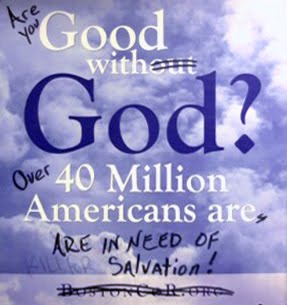
Anyway, as tends to happen when I sit down and write, that was a longer digression than I was intending. And I'll digress just a little more before getting to my essay, by way of introduction to what I actually wrote about: many (probably most) Christians rely on their faith and God as the source of their morality, and to a great degree, meaning, ambitions and motivations. As a result, many assume that non-theists, with this source of all morality and meaning ripped out of their lives, have no moral structure and no meaning in their life. I've heard this kind of rhetoric repeatedly from Christians who just don't understand that God and faith are not the only valid source of morality and meaning. There has recently been an effort by atheists to counter this notion, including billboards asserting that you can be "good without God." I'm a huge fan of this effort, but it has ruffled a lot of Christians' feathers, to the point that many of the billboards have been vandalized in various ways. I sort of understand (but disagree with) the opposition, and am severely disappointed by (but unfortunately not surprised by) the vandalism. But anyway, that's another topic, I have an essay to excerpt from. Maybe more on that later. What now follows is an excerpt of my career essay that does a decent job of detailing what my morals, ambitions, motivations, and goals are in the absence of faith. Because I do, in fact, have a decent moral framework that is not dependent on God any kind of faith. Anyway, slightly-edited-excerpt time:

To answer whether or not I see God's direction in my career path, what talents God has given me, and how I see myself serving God in my career, my answers are, simplistically, "no", "none", and "not", respectively.

Of course, it is a little bit more complex than that. My parents, for one, would certainly argue that God has given me these talents, whether I acknowledge it or not, and that God has been guiding my career path, and indeed life, regardless of whether I acknowledge God or not. And if God does indeed exist, and is something similar to the Christian God, that would be true. Additionally, I don't pretend to know for sure whether or not there is a God, and whether or not he or she has done these things in my life. But none of my conscious motivation or decisions have really taken that into account. What has affected my decisions significantly is my personal beliefs and morals, which are certainly influenced by my Christian upbringing, and still bear significant resemblance to generic Judeo-Christian morality. But prior to coming to college, and processing through significant discussion and 40,000 words of blogging, my motivations for such morals were solely out of conformance to my upbringing. That base has now shifted to a vague moral humanist kind of foundation, built on a basic belief in common human dignity and human rights, and some sense of the ubiquitous Golden Rule – things that are hardly exclusive to Christianity, or even theology. But that is from whence my motivations stem.

As for God's role in my life? As far as I can tell, and as far as I'm concerned, my talents and aptitudes are a result of genetics, upbringing, opportunity, and generally, the great cosmic dice of stochasticity. I realize that I am insanely privileged to have drawn the metaphorical lot that I have – a heterosexual, cisgendered, white, middle-class American male attending a private university with talents and skills that I was given the opportunity to build, take advantage of, and expand upon, and ones that, with the aforementioned education, usually result in a solidly upper-middle-class starting wage. My consciousness of this privilege, along with my other beliefs, motivate my desire to use those skills and resources, within and beyond my career, to advocate for minorities, support those fighting for human equality whenever I can, and work to end oppression, discrimination, and economic disparity where I can. This can include something as simple as contributing monetarily to organizations and efforts that do this work, as well as things like using my skills for things like building a website for Haven, working for organizations like Agros International, and getting directly involved myself in advocacy and assistance.

So these are the things that influence my day-to-day and long-term choices, rather than morals and mandates stemming from God or a Christian worldview. And these are the things that will continue to motivate my life, regardless of where my faith, or lack thereof, ends up landing. Any faith I ultimately embrace will necessarily be very concerned with these kinds of priorities, and the root motivation will likely be bolstered by whatever theology I may end up with. My career path decisions thus far have largely been motivated by opportunity and alignment with my skill and talents. As I mentioned above, I am very fortunate that those things line up with a career that is in demand and well-compensated. These motivations are influenced by my moral framework and beliefs – working for Agros, for instance, was an excellent pairing of my passions and skills with my beliefs. And beyond that, my greater vocation – what I do with my time and other resources outside of my job – will be greatly influenced by that as well.

So briefly, I see myself not so much serving a God that I don't understand or believe in as much as I see myself serving a humanity that I see very clearly all around me – working, as best I can, to make the world a better place for everyone, especially those less privileged than myself. I am in a good position to do so largely because of the talents, skills, and aptitudes that I ended up with through a combination of nature, nurture, and luck, and I intend to use that position to work for the bettering of the world in general. That is my service, my motivation, and my career plan.

Wednesday, March 23, 2011

Some responses to my update

As often happens when I say things (especially since these cross-post to Facebook), people responded. My last post generated intriguing and particularly wide-ranging responses, so as often happens, I'm writing a response post, because any response comment would just be an endless, impossibly thin column, and it separates original responses from any responses to the response, so it's better for everyone.

So! First of all, a few specific responses, moving into some more general response, with specificity sprinkled liberally throughout.

Tyler surmised that I don't like Dawkins and Falwell because they are "confrontational." That isn't quite right. I don't dislike Dawkins and Falwell simply because they are confrontational. I dislike them because they are dismissive, angry, and publicly and shamelessly place people who don't think like them almost at some lower level of humanity. Both of them horribly distort and misuse their belief systems, or at least how I believe their belief systems should treat other people. Central to my belief, regardless of whether I believe in God, is the humanity of humanity - that we are all people, all worthy of equal respect and dignity, and should be treated as such, with respect and deference. It's moral humanism on one side, a more social justice Christianity on the other, and the Golden Rule no matter where you come from.

And I'm not really irritated by people trying to convert me - mostly just amused, actually. Because I've been there, done that, heard all the reasons and arguments, hell, advocated most of them. I highly doubt anyone trying to convert me is going to tell me anything new, and no one thus far has. That doesn't mean I know everything - I certainly don't. But anyone who is trying to convert me isn't likely to tell me anything I don't. And it is true that the people who have been most influential in me not just throwing the baby out with the (pretty damn brackish) bathwater are mainly those around me who are confident in their faith and make no attempt to convert me - only understand me better, if I ask them about things. These are people who have years of experience on me, people who I know think hard and critically about their faith, and admittedly many of whom share the same periphery that I do. Many of these are professors at SPU, and are a large reason I am thankful for my experience here.

And as for Danny's (intentional or not) pointing at the historic witness of Jesus. That is something I need to look at more, which is an interesting challenge. There is, of course, the Bible, and books like Case for Christ (which I read back in the day), but those are, for very good reasons, pretty one-sided. We did base our calendar around the guy and swear by him, but that's because we're Western culture, which is increasingly becoming Global culture. The Arab world had their own calendar and swears, before the world became standardized on Western culture. Christianity did spread, but much of that spread (Constantine, the Holy Roman Empire) were not reasons that I can exactly get behind. So there's that. But I do need to have a good idea of what to do with Jesus existing historically regardless of where I end up, which I don't really right now.

Which kind of brings me to the central issue - whether or not an "intellectual conversion" is at all possible, at least for me. Danny separated "faith" from "relationship with God", and I don't think that's a meaningful distinction for me. I spent the first twenty or so years of my life doing Christianity just fine, purportedly even believing in it, whatever that means absent a relationship. I certainly adhered to all the principles, argued for them, and was ready to tell others why what they thought was wrong if it didn't match my perspective. But that all fell apart when that faith's foundations crumbled. That faith was based on things like opposition to evolution, the evils of the world, fear and avoidance of Hell, conservatism, and a whole lot of really terrible analogies. My faith was defined by what it was not - it was not tainted by liberalism, it was not doing bad things, it was not going to Hell, and significantly, it was not really questionable, because it was not wrong. Obviously, things kind of fell apart when I realized that evolution was science, liberalism wasn't all hell and brimstone and really at the core is being more concerned about people, Christianity isn't primarily about getting a ticket to heaven, and the world isn't going to corrupt me if I don't shut it out. I suppose it did corrupt my conservative evangelical Christianity pretty thoroughly, but that's not nearly a bad thing.

So I've done a faith about knowing, about arguments, about being convinced. They ended up being really bad arguments. And maybe there are good arguments out there, but I still am repulsed by the idea of someone having to convince me that there is a God. Especially when so many have failed, and have presented pretty poor excuses for arguments. And Christians seems predisposed to arguments that include "Christianity is right" as an assumption somewhere, even though they don't realize it. But even if there were good arguments - if "faith" is separate from (or at least not a result of) "relationship with God" - I don't think it's a faith that I want. It feels like a very empty faith, a meaningless faith, and if this faith is going to have a significant effect in my life, be reason for doing things, that's not what I'm looking for.

I'm not sure what I am looking for. If anyone else is involved, I think it is more of someone introducing me to God than convincing me of God - but that's complicated because God isn't corporeal, and it sounds annoying to boot. I'm not trying to make God into anything specific, or put God in a box, or really require anything of God - except that God shows up in some recognizable fashion. Not in the fact that my life has been pretty good thus far, or that something unlikely (but still feasibly possible) thing happened. Nothing that proves to me that God is there. Matt, I agree that any experience used to prove God's existence is pretty questionable. And experience isn't reliable, but it's all we've got, really. If the only time I experience God is while I'm getting a root canal, it's unlikely that I'm going to do much with that. But even if I initially experience God while getting a root canal, but then continue to be able to communicate and experience going forward? That may be something different. I'm not sure. I think I agree with your and Danny's consensus though.

The point being, if I'm going to have faith, I want it to be based on knowing that God is there. That can only come through first-person experience, like Kristen's that I mentioned in my previous post. And whenever I talk to someone and we're past any proving or arguments or such, it always comes down to that. It was a similar situation whenever Becky and I really talked about it. They just know that God exists, and have some kind of relationship with God. They don't have any arguments or reasons that convinced them. They have supportive evidence, but none that makes any sense without the experience of God existing.

And I don't really have anything that I want God to be. I have a lot of ideas of what I don't want God to be that mostly boil down to "hypocritical". And I suppose, with that, some basic parameters - just and loving for starters. And pride is certainly a factor. It's always a factor. I'm human, perhaps more prideful than most. But I also don't want "pride" to be an excuse to dismiss my ability to know anything, or be confident in anything. Because I don't think it's prideful to think that modern science, for instance, knows a lot about how the world works. Not everything, not enough to rule out God (which is probably impossible anyway), but a lot. Certainly a lot more than 2000 years ago. "Pride" is too often used to just dismiss anything the dismisser doesn't like. I'm not in any way accusing you of doing so, Evan - I actually very much appreciated your thought. I just don't really know how to not be prideful, but at the same time have a faith that is rational and reasonable and has intellectual integrity. I suppose maybe I don't trust God enough to be that - I spent too long believing that God hates science and evolution and thinks reason is dangerous, primarily a tool of humanity to explain God away. I'll have to think about that one. Thanks.

And Nicki, you just posted, but your post lines up nicely with what I was going to wrap up with anyway, so here goes! One of the big problems with most reasons I'm given to believe is that I'm perfectly content, right now at least, to live without God. I don't need a God to explain how I got here, why the world works. I don't need a God to motivate me to be good to my fellow human beings, to follow the Golden Rule. To take the relationship analogy perhaps a bit far, I'm happily single as far as God goes. I wouldn't mind a relationship. It might well make my life better and fuller. But I don't need that for anything. Perhaps that's the wrong attitude to take - but if I were to pursue God as if I wanted God more than anything, I would have to do a lot of playacting, and I've done quite enough of that in my life already.

And for the record, I do go to church. Not really for any terribly spiritual reasons, and certainly because of a certain amount of momentum, and a touch of expectations. But primarily, at my home church, there are good people who care about me, and many of whom are some of those good examples above, who are confident and thoughtful in their faith, but don't try to push that on me. Sometimes I go to other churches, many of which remind me that not everyone is doing things horribly wrong. Some (Quest, for example) are doing very good things. Yet others remind me that, yes, some people still are using Christianity in ways that I find repulsive. I limit my visits to such places, but even at some places, there are kernels of right.

I'm not sure how to actively put myself out there without presuming things that I don't believe. I'm open, I'm even willing to do a little investigation, if from a noncommittal perspective - reading the Bible not as a book of my faith, but as the book of Christianity. But much beyond that - actively seeking - ends up requiring too much pretension and acting. Again with the likely inappropriate extension of the relationship analogy: actively seeking out a relationship, as if you desperately need one, is a bad idea. I'd much rather run into someone, at the Teacup, downtown, at a bookstore, on the bus, and have things go from there. That's a little harder with God, since God has no corporeal presence, but if I continue on through life, open to the idea of a relationship with God, and God is around and interested, I'm betting I'll run into God sometime along the way.

I get annoyed very quickly with Jesus-is-My-Boyfriend-type things, and painting God as a romantic relationship, but I think the analogy works okay here. It's true of any relationship, romantic or otherwise. If I'm not interested, closed off to new relationships, it's unlikely I'll start any. But if I'm open, but not actively looking, I'll probably run across some. Some friendships and/or relationships I run into will greatly interest me, and I'll pursue them. But looking for relationship for the sake of being in relationship isn't what I want to do - in personal relationships or God ones.

So, to exit the relationship analogy, which has been stretched quite enough. I'm quite content right now to be a moral humanist. I don't need God to fill any holes in my life, which I don't think should be God's function anyway. I have a basis for morality (common human dignity, basically), an explanation (enough, anyway) for how the world got here and how we work (science), and meaning in life (making the world a better place for those who surround and will follow me, and enjoying the time I have). I'm not opposed to God showing up, or having a relationship with God. But it's not really something I need to sustain me. If God exists and is a relational God, I'd be quite interested in getting to know him, her, or it. But I have no reason to assume that is the case, so I'm going to have to run into God somehow - in a way that I recognize - to get that started. Which, I suppose, is what I'm waiting around for.

Thanks, all, for your input - it's got me thinking, and I probably didn't address everyone's points in here, but rest assured I read them and will mull them over, because they are all great thoughts. And I would be glad to talk with any of you about such things - I always love fleshing things out in person.

Wednesday, March 16, 2011

A brief update on faith, theism, God, and me

It's been far too long since I've posted here, I've been busy with all kinds of life things, and have been spending more time over on Tumblr as well. But I just posted over there something that would make just as much sense here, that kind of explains why I haven't been posting as much here. So here goes.

I have been reading a thus-far intriguing book called Cloud Atlas, but I left it in the library yesterday and it hasn't showed up in their lost and found yet.  So I resorted to reading the other book that has been langushing in my laptop bag for far too long, ever since my father read it and gave it to me.  Said book is There Is A God by Anthony Flew, supposedly "the world's most notorious atheist," who I had never heard of.  After reading, evidently he was a lot bigger among philosophers in the 60's, 70's, and 80's than he is these days, which would explain my ignorance of him, but I still think the claim is a bit reaching.  In 2004, he apparently came out as believing in God, and some atheists got pissed, and religious people all over got really excited.

Now I'm a little underwhelmed by all of this, because he's only a deist, and doesn't even believe in the afterlife, which makes it a rather Pyhrric victory for Christians, I would think.  And some of the endorsement quotes were less than heartening.  Francis Collins crows that "Flew's colleagues in the church of fundamentalist atheism will be scandalized," the Denver Post calls it an "Intellectual conversion of great significance," and I've been highly disappointed and extremely skeptical of "intellectual conversions."  But I've nonetheless made it through half of the preface and the introduction and two and a half chapters thus far.

I gave up halfway through the introduction, because I decided that its author, Roy Abraham Varghese, is, or at least comes across as, a pompous ass who gleefully delights in pointing out the apparently hilarious failures of atheism.  Of what I read, he spent about a third of it quoting the likes of Richard Dawkins and another promoting Flew to almost godlike status in his philosophical brilliance (without, of course, mentioning that he's a deist at best).  It's full of gleeful dismissal, and absolutely maddening to read.  And I've long held that if someone gets to hold out Dawkins as an example of reasoned, respectful atheism, I get to pull out people like the late Jerry Falwell and James Dobson as examples of reasoned, respectful Christianity.  From what I know of him, Dawkins is as bitter and gleefully dismissive as Varghese, and I want nothing do do with him.

So I gave up on the preface, hoping that Flew himself, having been an atheist for fifty years, would have some semblance of respect for the position.  I haven't been disappointed - he hasn't made me want to throw the book across the bus yet, for instance, and has been very respectful of both sides thus far.  But he also has spent three chapters talking very dryly about the various philosophical papers and debates he's been involved in, how he chummed with C.S. Lewis, and his various schoolings and romantic endeavors.  I suppose this is kind of an autobiography, but it's been a dull, frustrating, mildly but not egregiously self-important one.  Certainly not raising himself nearly to the importance that Varghese did in the preface, or I would no longer be reading this book.

The first chapter was interesting, in that he discussed his upbringing, which was rather similar to mine - a preacher's kid who did all the right things mainly to fulfill expectations but never had any heart or real interest in it, faced questions that he was in no way equipped to handle, and gave up.  I haven't been quite as conclusive as he was, but the similar background will hopefully be beneficial.  But after that, as I said, a bunch of paper titles and summaries, and name dropping, and not much substance.  There was a brief dismissal of determinism that I found altogether dissatisfying (because I have thought about these things) and he called the basic "first cause" argument "formidable," (I don't think throwing God in as yet another proximate cause really helps anything, no matter how much you pretend God magically gets to be not proximate), but that's about it.

But he promises to actually get to the challenging and arguments for God in the next seven chapters, so hopefully there will be things of substance in there.  But I admit that I highly doubt Flew will be successful in doing anything but frustrating me with mischaracterizations or improper dismissals, because so-called "intellectual conversions" have always left me wholly wanting and completely unconvinced.  

In fact, I don't think anything is going to happen on the faith front until God decides to show up.  That might sound a little defeatist or apathetic, but I don't really have any good reasons to have faith, and I don't understand reasons for faith other than "God exists, so we should get to know him/her/it."  Trying to argue God into existence or threaten me with consequences if I don't believe isn't going to cut it.  And really, I'm jealous of those who have experienced God, and I don't think it's fair that I haven't.  I'm not opposed to the idea at all, and I'm not opposed to theism.  But I just don't have any good reasons - making my family comfortable is not sufficient reason to lie about my motivations for everything in life and basic beliefs.

Earlier, Kristen posted a section of her admissions essay, which contained this brief excerpt:

It was at this retreat that everything changed. While my friends raised their hands fervently in praise during worship and knelt piously in the aisles for the altar call, I sat in the back, scornful and skeptical. And God, with a gentle persistence I would learn to recognize and appreciate in coming years, showed up. It is difficult to describe this experience fully, as I suspect words could never do it justice; however, in that time, God was there. God was real. We sat together for the remainder of the service, at which point God obligingly moved on and I was left joyously pondering my newfound revelation.  I still lacked understanding, but this experience provided me with a basic foundation of faith from which I could begin to seek.

And I was jealous.  Because at this point, I'm not even that scornful or skeptical.  Just a little cynical, but that's mostly at Mars Hill and the like.  Why doesn't God bother to just show up?  If God exists, why does ze insist on sitting back on the sidelines, watching me flail around, being offered pathetic, circular, and in general unsatisfying arguments for zer existence, witnessing all kinds of miscarriage of Christianity and Jesus' stated goals?

And it's that, really, that has been why I haven't really posted here. I haven't really gone anywhere spiritually recently. I've cut out all of the parts of Christianity that I found unnecessary, hurtful, and problematic, I have a fairly coherent Christian theology, at least for all the peripheral stuff, that I would be willing to adopt. But I don't have any good reason to embrace theism, much less Christianity. And I don't think that's something that can be argued or reasoned, I think it's something that can be experienced. Because all of this God-talk, all of theology, doesn't really make sense if you don't have a relationship with God. And I don't, and I don't know how to. And as the omnipotent, invisible, imperceptible being, I think it's kind of God's job to reveal Godself to me, because I can't hop over into whatever ethereal realm God resides in, and all attempts to pray or read the Bible just end up with me talking to myself and getting mad at how the church has misused Scripture.

So until that revelation happens, I doubt I'll be convinced.  I'll read the book, I'll continue discussions with my father and others who care about me, I'll keep my options open, but I can't think of anything that would convince me.  It's not for lack of trying, it's not because I just haven't heard your awesome argument.  It's because arguments aren't what I'm looking for.

Sunday, July 18, 2010

Theology, one word at a time

We are often asked to describe something - our life, our ambitions, ourselves - in a limited number of words. Sometimes one, sometimes two, maybe three. Ernest Hemingway is famous for his six-word story: "For sale: baby shoes, never used," and the idea has inspired many similar efforts across literature and the internet. This interest in distilling something - ourselves, a story - into its smallest possible form is strong and widespread, because it requires every word to count - discarding only the most essential of essentials, to arrive at the purest essence of its subject. Pondering this, I thought it would be interesting to write my theology in one word, then two, then three, and so on, as a unique (and hopefully helpful) way of expressing the most important aspects of my faith, and going outward from there. Each summary must stand on its own, without its surroundings, and be true to my beliefs. The first word is easy, since I've titled my creed of sorts a "Theology of Love." So I'll start there. This, I hope, will be a work in progress, hopefully improving (and not just growing) as I go. Getting too long may start getting unweildly and not as useful, but thus far, figuring out what one word needs to be added is hard. We'll see.
  1. Love.
  2. Love everyone.
  3. God is love.
  4. Love God, all humanity.
  5. Love your neighbor above yourself.
  6. Always share God's love. By example.
  7. Love everyone perfectly. Any failure is sin.

Thursday, July 8, 2010

Homosexuality, the Bible, and the Church (and me)

This is cross-posted from my Tumblr, because it ended up being substantial enough to justify its own blog post.

I believe that there simply isn't definitive enough Biblical mandate against committed homosexual relationships to justify anything less than embracing our homosexual brothers and sisters as God created them, and loving them for who they are, and that there certainly isn't enough to justify excluding or condemning them.  I don't see sexuality as any different at the core than the issues of female clergy, abolition of slavery, or interracial marriage.  There is at least some scripture - applicable today or not - that can be interpreted as contradicting all of the above.  But there's a consensus on the last two, and generally at least extradenominational tolerance of the first, that just doesn't exist for sexuality yet.

The few scriptures on the issue are at best not definitive, and as I read them either ambiguous or not applicable. Taken against the central mandate of love, considering the integral part of a person that sexuality is and the witness of my gay and lesbian friends and acquaintances, Christian and non-Christian, I can't in good conscience condemn them for being born gay.  I am, in fact, convicted to love and embrace them and their sexuality.  Such action is doubly needed precisely because of the fear, condemnation, anger, and doublespeak directed at them by much of the church.  As a result of this, gay and lesbian Christians are too often alienated and distant from the church, Christianity, and Christ, for reasons that I believe are invalid.

In light of the Presbyterian general assembly voting earlier today to allow non-celibate gay clergy, I was asked on Facebook why I was in favor of the vote.  That's what I came up with, plus a little expansion.

It's certainly not the entirety of my views, and doesn't have the specifics.  My final essay for one of my classes, while somewhat dry, has more of them.  But it's a good summary and gist, which I think is helpful.

In regards to the assembly, they later voted to not discuss or vote on any changes to the definition of marriage, which was another of the proposals, and the gay clergy has to be approved by the churches (which a similar proposal failed at two years ago), but it's a step forward.  Objections or reconsiderations of the non-discussion vote are still theoretically possible, but there aren't any indicators of if that will happen.

Sunday, June 27, 2010

Letting Go

Recently, I've been feeling stuck. I began this endeavor by dismantling the religion I inherited, discarding the parts that were inconsistent, or flew in the face of my experience, my relationships, or my reason. This left the remains of my inherited theology on the floor in pieces, largely because that worldview was very monolithic - it came as a package, questioned either as whole or not at all (as always, I've got another blog post about that). What I've picked up so far is, in a word, love.

Love for others, a respect for the world we live in, an obligation to care for those who need it, a mandate to put others before yourself. All of this comprises a huge part of what Jesus had to say while he was on this earth. But when I try to take this and set it up as my theology and continue as a Christian, I run into a problem.

Namely that being a Christian, at least to pretty much everyone who cares whether I call myself a Christian, isn't about that. At least, that's what it appears to me. Don't get me wrong - it's a very important part of being Christian. It's what you do as a Christian. It's what Christ calls us to do, what God demands of us. I've got that part down.

But it's not what determines your status as a Christian. What makes you a Christian (where I come from, anyway) is having a ticket to heaven. Because you can very well do all of those things I mentioned and not believe in God - I know, because that's functionally what I'm doing. So what makes me think I am a Christian?

I don't know. As I try to put together any coherent vision of salvation, it crumbles when I realize, for instance, that I don't really believe in Hell. And it's not helped by the fact that to this day, I still have no conception of what it really means to "believe in God" or "accept Jesus" or even "pray". I know what all of that looks like from the outside, and I know how to "do" it. But there's no soul to it - no meaning, no actual understanding. It's like a life-size model car, that by all appearances is just like all the other cars, but has no engine, no drivetrain, nothing that makes a car a car. A fantastic illustration of this is the cargo cults left behind by World War II.

The upshot of this is that what tenets of theology, what faith that I do have, if you can call it faith, are things that are supposed to be the result, but I don't have any of the motivations or underlying beliefs that are supposed to produce that result. I have built motivations and support for that result, independent of faith, divinity, God, or religion, on a very humanist basic conception of common human dignity. So when I go to try to figure out what to do with God, it's all just theology and salvation, and I keep running into things and people that tell me I'm wrong, I can't have arrived at this conclusion the way I did, my motivations are invalid, I just don't understand. They say that because of that lack of understanding, my wrong motivations, I don't see that homosexuality is a sin, people like me are going to Hell because I didn't go about it the right way, I can't just ignore that, I'm veering off of the highway of Christianity and getting lost in the woods, I don't love Jesus, I'm losing my faith, that's a slippery slope, and by the way evolution smells funny.

The problem is, for those kinds of purposes, I don't claim to be a Christian. In reality, I never really have been, and I've come to terms with that. I can't veer out of what I'm not in. And trying to jump into that kind of (part of?) Christianity is exactly where I don't want to go, because I've been there, and it blew up in my face. But every time I try to approach God or spirituality, all of that flares up again, because it's the only way I know how to try to deal with God. And it's all hollow, and has no significance or meaning to me, and again, much of it flies up against what I do know and believe, and I can't put together a coherent theology, because I do too many things "wrong". It's a problem.

I've talked to my girlfriend about this, as she has a much different relationship with God - one that is grown out of herself, her own experiences and beliefs, and not encumbered by all of the trappings that I run into. Her advice was basically to decide what you're going to do - find some way to figure out how God fits into this, or strike out as a secular moral humanist - and do it. If I'm going include God, do just that - and eschew the rest of it.

And as I sit here, with all of the text and processing above, that sounds like a very good option. So I'm going to try it. Bascially, saying "God, this love stuff? I'm trackin'. Love my neighbors? Care for the least of these? All of the beatitudes? I can get on board with that. The rest of this mangled wreck that is my dismantled religion, from which I've salvaged those precious few tenets? Not so much, and I don't care. It's behind me now, and I'm starting over with nothing but love."

That sounds good. Am I personally capable of doing that? Maybe so. Am I allowed to do that? Frankly, I don't really care. It's a struggle as much with my own internalized religion as it is with any external opinions or forces. And I'm fairly confident that if I am able to do it, it will only be if I refuse to be held to that scaffolded religion that I came out of, refuse to be questioned by it, and stop trying to reconcile it. That may (and probably does) come across as arrogant, dismissive, wrong, horrible, even sinful and blasphemous. But that's not my intention. I simply don't see any other way to move forward, because the more I look at it, the more I realize that what I'm doing isn't working, and I don't see a way to make it work.

I think I'm to the point where I simply can't fit the pieces of my former worldview back together, because it's broken, it's missing huge portions, and it was never intended to be taken as anything but a whole anyway. I have to, as David Bazan so eloquently put it, "let go of what I know and honor what exists." In fact, that song (Bearing Witness) keeps getting more accurate in describing what I'm dealing with that I'm just going to paste the lyrics in here, to finish out this post.

I clung to miracles I have not seen
From ancient autographs I can not read
And though I've repented I'm still tempted I admit
But it's not what bearing witness is

Too full of prophecy and fear to see
The revelation right in front of me
So sick and tired of trying to make the pieces fit
Because it's not what bearing witness is

When the gap between
What I hoped would be
And what is makes me weep for my kids
I take a cleansing breath and make a positive confession
But is that what bearing witness is

Though it may alienate your family
And blur the lines of your identity
Let go of what you know and honor what exists
Son, that's what bearing witness is
Daughter, that's what bearing witness is

Listen to it, it's good stuff, and pretty much sums it up better than I ever could.

Pre-emptive reponse note:I know there are those who will read this and end up with the reaction that I am falling away from the faith, I'm giving up, I'm being pulled in by the deception of the world or Satan or Seattle or gnosticism. For the first couple, I can say that I'm not. This is the only way I can see forward, and trying to put pieces together that are horribly broken and were never meant to fit without the whole anyway is futile. To the last point? If you want to think that, you can. You could be right. And if you are, and if God really cares enough about all of the periphery and structure that I'm putting behind me, you can trust that he'll confront me with it eventually. But pointing out where I'm stepping outside the bounds of Christianity, or where the Bible says I'm wrong, simply isn't going to be helpful or useful. Because it's me and love, trying to find this God that everyone keeps talking about, and that's it.

I do plan to be reading the Bible on the way, but being very aware that I've been trained well in how to read the Bible "right," and am aware of how that colors, frames, and distorts what God is actually trying to say. One thing I have learned is that Biblical literalism, and many understandings of inerrancy, get in the way of understanding what the Bible actually is trying to say, and I intend to read it with that in mind.

While I was typing this post, TweetDeck popped up Roger Ebert's latest tweet: "If a good man is refused heaven and a bad one let in because of a technicality in church law, that doesn't speak well of God." Appropriate.

Tuesday, June 15, 2010

Germany, Capitalism, Immigration, Sodom, and our "Christian Nation"

I've long been aware that the reason Sodom was in such trouble with God had little do to with their homosexual relations and a lot to do with their vicious inhospitality, but the other day, I came across a good summary of scripture, Jewish writings, and historical documents that bear that out. I posted it on my tumblr and Facebook, the latter of which resulted in the following question:

"Why the cheap shot at Arizonans? Especially given the fact that the controversial law is essentially equivalent to a federal law already on the books?"

And I had to admit, the cheap shot at Arizona was somewhat unfair. I was going to add a disclaimer that I'm still a keeping a careful eye on the Arizona law, and don't condemn it as strongly as many do, which is true, and which I did.

And to answer the question, I wrote this blog post. Because I want to be clear, and the issue at hand is much bigger than a law that Arizona passed. In fact, I would be glad to generalize my criticism to the country in general, and have amended my Tumblr post accordingly. So, my answer:

I was referring not solely to the new law, but to the general attitude it belies and embodies: protecting our country's precious and supposedly self-earned resources from invaders from neighboring nation - the assumption that what we have earned is solely our own, and we have no obligation to share it with others or care for the stranger, because we earned all that we have.

As Josephus wrote:

"They no more remembered the benefits that they had received from [God], hated foreigners and declined all intercourse with others"
And the rabbi at the bottom:
"The men of Sodom had no consideration for the honour of their Owner by not distributing food to the wayfarer and stranger, but they even fenced in all the trees on top above their fruit so that so that they should not be seized; not even by the bird of heaven"

We, neither as a country nor as the state of Arizona, have obviously not quite gone to this extreme. But Sodom is a cautionary extreme - a parable of sorts - that cautions against the rugged and jealous individualism and entitlement that was exemplified, and which is prevalent in modern America to a great extent.

In my opinion, if we are to be a "Christian nation," we cannot stand for this conception that what we earn is our own, that we deserve all that we have, firstly because it is patently false, on an individual and national level, and secondly because Scripture strongly condemns it.

That doesn't necessarily make for good business, and it doesn't work well if you run a nation that prides itself in its power, independence, and economic status, but that doesn't mean Scripture is wrong.

I believe that Christians should be intensely focused on caring for the poor, sick, and needy, with less concern for yourself than for your neighbor. You don't have to believe that we need to do this as a nation, but I don't see how you can call it a Christian nation if you don't.

I recently came across an article about Germany's capitalism, which I don't know anything about besides this article, but from what I read seems more in line with being a Christian nation that practices capitalism than our dear old US of A. They have an extensive social safety net, much more so than the US. And it's expensive, but that's an expense that Germany is willing to bear.

The conservative concern with big government, overspending, and general ineptitude is a valid one, and one that I don't dismiss. But personally, I would prefer to have a country that overspends and is inefficient, but has an effective safety net for our citizens (as a start) and welcomes immigrants as those see how our country treats its citizens and want to join it. This is a better end goal, I believe, than one that is fiscally sound and has all its books balanced, but leaves people to fend for themselves, asserting that they should just pull themselves up by their own bootstraps, regardless of their family or environment, and looks upon immigrants as a drain on our economy that we deal with by making them jump through a long process of hoops, and then hunts down the ones that fail to jump through all the hoops.

I realize that there are many immigrants that are here as drug mules and part of the narcotics trade, and those that are violent offenders. But I believe that those issues should be dealt with by dealing with those issues - not by cracking down on all immigrants, regardless of their involvement with the drug trade or violent tendencies, who didn't manage to make it through the immigration process. I don't have any personal experience with it, but the accounts that I've seen and the huge berth of attorneys who specialize solely in immigration issues testify to a long, arduous, and overcomplicated system that is broken in many ways.

Sunday, June 13, 2010

A defense of social constructivism

I recently wrote an essay for one of my classes, and this paragraph turned out particularly well, something that even my professor pointed out, so I thought I would post it here, since it's very relevant to my struggles with faith and morality, as I find myself functionally being more of a moral humanist than anything else.

The idea that morality is built up from society, tradition, and experience of humanity over time seems much more appropriate than an absolute but obfuscated rulebook being handed down as the foundation of morality. I don't see why there is implicit authority in imposing a morality from a religion, whose particular conception of morality tends to change over time as the rest of culture and humanity change, despite supposedly being handed as absolute from on high. If God were a being that interacted with the world in direct, clear, and universally recognizable ways, there would be a good reason for religion to have a special claim on morality. But in this world, there is at best indirect, abstract, uncertain interaction between the divine and humanity. So to the questions often posed to those who assert morality without God — "By what authority do you enforce human dignity? Who gives you the right to say that I have to respect the dignity of my fellow humans?" — I reply that dignity is endowed simply by being human and sharing residence of this world, and I don't believe that pointing at tradition and religion endows Chrisitans with any special authority on the issue, when I have no basis for attributing any authority to a particular understanding of God and, most importantly, don't believe such an authority is necessary to give humans humanity.

Tuesday, June 8, 2010

The audacity of the homosexual lifestyle

Recently, one of my friends posted a link to an an article about a fairly typical Christian response to the growing prevalence of homosexuality in our culture, especially television, which is seen as an assault on good Christian heternormativity. When posted on Facebook, my friends were surprised by it. I was not. In fact, when I heard that there were openly gay characters on Glee that were being portrayed as (of all things) normal, the first thing I thought of was of the condemnation that Christians would undoubtedly heap upon it. This, in long, is, as best as I can tell from years of observation, why:

If you know that the gays are not only openly and boldly sinning (or at least misguided, see: Glee), but doing their best to convince, or even worse subtly suggest (again, see: Glee) to poor children suffering from same-sex attraction that their feelings are not evil, sinful, and unhealthy, as God and you well know (and as God lays out in thousands of verses...oh wait, that's loving your fellow humans and caring for the poor).

These gays, and their evil depraved liberal compatriots are trying to push onto their young, impressionable minds that it's not only okay, but perhaps even something to be celebrated and embraced. They're trying to take this depravity and ickiness and turn it into something...acceptable. And you can't have that, because then these children might go as far as to not believe that they are depraved and sinful, and refuse to go to the psychological manhandling that is ex-gay camp, and turn out to be normal, healthy, well-adjusted homosexuals. And if too many kids end up doing that, instead of being repressed, shamed, and pushed to the margins of society, then what will happen to the examples to point to to prove your point?

What of those who have destroyed families by coming to terms with their repressed sexuality halfway through a false marriage? What of the youth who are having sex without guidelines, because they are already completely outside of their rigid Christian morality anyway? We can't have all these Neil Patrick Harrises prancing around. If everyone ends up appearing normal by all appearances, and even good, even decent faithful Christian God-fearing homosexuals, who will you point to to demonstrate the depravity? How will you preserve the holy heteronormativity?

What examples will you use to paint these individuals as outside of God's ideal with a wide brush, like singles, and women, and blacks? Or not the last one any more...Christianity has figured that one out. Get with the program. And women are mostly okay these days, as long as they don't get to heady about it, and depending on who you ask.

You can't.

And that's the problem.

It may just be that I have spent too much time trying to deny to myself that these viewpoints exist and are widespread, only to be proved wrong, time and time again. But I was not surprised by this. Not in the least. Dismayed? Re-disappointed? Annoyed? Yes. But not surprised.

And I know many people who fall within my wide caricature here, including my own family (hi, Dad!) and friends. And I am well aware that not every Christian who is against homosexuality believes all of this. I know that I am myself painting a wide brush, and being overly general and vindictive. Which is because all of this sounds pretty ridiculous to me and you, but if you insert at the base of it a solid, sincere, God-fearing, honest-to-goodness conviction that homosexuality is evil, not God's intention, a perversion of humanity by the world, and all of this is just the devil, speaking to me, the producers of Glee, directly or indirectly by the liberal establishment, the media, and shows like Glee, most of it makes sense. And I almost understand that, in my rational mind. But the way I put it , it sounds ugly and crazy, because if you don't have that conviction, it is ugly. Ugly, petty, and wrong.

I don't have that conviction.

And I don't think there is anything - not in the Bible, not in rhetoric, not in my family, not in pity or prayer - that will change that.

The wonderful (and heck, the so-so, if there are any) gay people that I know and love, who have struggled with Christianity, struggled with their families, their community, and themsevles, and ultimately concluded that there is nothing broken within them, that it is the world and their religion that is broken, are a testimony. A frighteningly unassailable testimony. And it'll take more than fearmongering and prooftexting to change that.

Many of those (my father) who I think of most when I go off like this are wonderful people. Sincere, God-fearing, loving, beautiful people. And they don't necessarily campaign against homosexuality. My parents, and 67% of my home county, voted against it. And flinch at, and probably comment on, the pervasive homosexuality (and therefore immorality) in television, the media, and the world. The motivation for their beliefs and actions are rooted in a deep love for, conviction from, and belief in God. And to them, the above is biased and inflammatory, but under all the rhetoric, necessary and true. I think. Because you, I, Seattle, liberals, are decieved by this culture, by shows like Glee, by the world, by Satan himself, perhaps. God is looking down on us, shaking his head sadly, because we are being decieved by moral relativism, and we don't even know it.

Much like, to me, the religious right is holding to "tradition" when it needs to be reconsidered. Subscribing to rules when it is justice and people that need to be seen and considered. And being tricked into holding to lines and pillars of tradition, because they are safer and easier than progress. And God is looking down on them, shaking his head sadly, because they are being decieved into excluding and casting out his beloved, and they don't even know it.

That's the world I live in. It's messy, the lines I've painted are anything but firm or entirely fair, and I don't know what to do with it all the time.

So this?

This did not surprise me.

Monday, March 22, 2010

It Passed!

I've been twittering a good bit tonight about the healthcare bill that is on its way to Obama's desk. I haven't talked about such things much here, but providing decent healthcare as a basic right is something that is very much in line with Jesus' calling to care for the sick and needy, I believe. And due to the huge amount of fearmongering and politicking surrounding this bill, I decided to sit down and read the thing. Or at least a summary of the thing over at THOMAS - still no small feat, at over 20,000 words. But I read through it - skimming when it started getting into technicalities here and there. I'm not nearly a lawyer, but from what I understood, here's my overall summary of it:

Unsurprisingly, there was no dictated communist takeover of the country's healthcare system. What was there was the expansion of Medicaid to all the poor - the most important part of the bill for me. I wasn't sure, because it was a relatively short section. But Title II expands coverage to everyone below 133% of the poverty line, mandating it by 2014 and allowing it as soon as April 1 of this year. Previously getting Medicaid required you to be disabled, pregnant, or a child, with a few other qualifications. This bill removes those requirements. The bill also established a lot of basic requirements for health insurance - regulation of the insurance industry and of insurance plans to ensure that everyone (for some definition of everyone) has a given basic level of health coverage, and sets requirements for individuals to purchase coverage. It also, as promised, sets up a healthcare exchange that is kind of a central repository for insurance plans, monitored by the government. These were obviously the meat of the bill - health coverage standards, the individual mandate, and the insurance exchange - so they're in there for sure. There were also several sections that worked towards making information about doctors, healthcare plans, hospital ratings, and the like more available and open to the public. Additionally, there were many things to improve the existing programs, adding checks and requirements, and Title V added lots of funding to encourage students to go through medical school - loan forgiveness, additional loans, money to schools. These are all good things in my mind.

There was also a lot of fluffy language - requirements for things to be planned, "senses of the Senate," advising people to do this and that. I'm assuming this is pretty standard in politics, but it would be better without it.

Obviously, there was a lot more in there than that, but that's the quick version. I also took some notes of a few sections I found interesting or pertinent given everything that's been thrown around, that I've listed below:

  • Abortion, as I read it, is basically up to states, but there is no federal funding for abortion (Sec. 1303)
  • In addition to the expansion of Medicaid, people below 400% of the poverty line get special tax breaks for healthcare coverage (Sec. 1402)
  • The bill forbids discrimination against hospitals that don't participate in assisted suicide (Sec. 1553)
  • Coverage for anti-smoking medications is added to Medicaid (Sec. 2502)
  • There is funding for sex ed, both abstinence and contraception, with a special mention/funding of abstinence education (Sec. 2952 and 2953)
  • An Office of Women's Health is established in several departments (Sec. 3509)
  • If I'm reading it right, a federal mandate similar to the one in King County for restaurants to post calories and other nutritional information on their menus (Sec. 4205)
  • Special assistance for pregnant teens (Sec. 10212)
  • Employees at free clinics are protected under malpractice laws as if they were employees of Public Health Services (Sec. 10608)
For a more informed overview of the healthcare bill, check out PolitiFact's take, The New York Times' summary, or FactCheck's summary of recent arguments. But overall, I'm glad this thing finally passed, despite all the fearmongering, confusion, and deception that did its best to bring it down. Healthcare should be a basic right, all the more if you are concerned with the welfare of the least of these.

Sunday, March 21, 2010

A Theology of Love

"A theology of love." This post has been cooking for a long time. I've had that title in mind for months now. I've tried to start this post several times - I have drafts from ten months ago, four months ago, and a few in between. And as I look back, I think I've tried to make it too complicated. So here goes.

My theology is this: God is Love.

There's a lot packed in that sentence - firstly, for me to have a theology that I can actually believe in is a big step. It's been a long process. See my prelude for the "quick" version, and the rest of this blog for the long version. And as for the theology, it's more than just three words. But it can be summed up in those three words.

To elaborate a little, I believe that the very essence of God is Love. And I mean essence in the most literal sense possible: containing God's characteristic properties in concentrated form. An extract that has the fundamental properties of a substance in concentrated form. Looking at the various definitions, essence is actually an excellent word. The most important ingredient; the crucial element. The inherent, unchanging nature of a thing. The basic, real, and invariable nature of a thing or its significant individual feature or features. All of these definitions get at the relationship between God and Love. Basically, they are one and the same. Now, this isn't anything too radical - I'm pretty sure I'm on fairly solid theological ground so far. But where this begins to differ from a lot of theology is that I believe that Love is everything. I saved one of the definitions to illustrate this: Love is the intrinsic or indispensable properties that serve to characterize or identify God. I like that one. How do you characterize or identify God? Love. Take anything, and ask of it - is there Love? If not, I seriously question if it is of God, or represents God faithfully. I intend on taking this to its fullest extent possible - which has some interesting implications that I'll outline below. But I think I still have pretty good support. After all, a great man once said:

"By this all men will know that you are My disciples, if you have love for one another."
-Jesus (John 13:35)

But first, how did this come about? Well, during my deconstruction phase, I was looking at the things that are wrong with the Church (and this country, and society in general) - of which there are many - I kept coming back to what I call the "summing up" passages. There are several places in scripture "sums up" the Bible, the nature of Christianity, into a short space. They are arguably some of the most famous passages in the Bible. The Golden Rule. The Greatest Commandment. For example:

"This is My commandment, that you love one another, just as I have loved you. Greater love has no one than this, that one lay down his life for his friends."
-Jesus (John 15:12-13)

"And [Jesus] said to [the lawyer], "What is written in the Law? How does it read to you?"
And [the lawyer] answered, 'You shall love the Lord your God with all your heart, and with all your soul, and with all your strength, and with all your mind, and your neighbor as yourself.' And He said to him, 'You have answered correctly; do this and you will live.'"
-Jesus and the Lawyer (Luke 10:25-37)

"If I have the gift of prophecy, and know all mysteries and all knowledge; and if I have all faith, so as to remove mountains, but do not have love, I am nothing. And if I give all my possessions to feed the poor, and if I surrender my body to be burned, but do not have love, it profits me nothing."
-Paul (1 Corinthians 13:2-3)

"But now faith, hope, love, abide these three; but the greatest of these is love." -Paul (1 Corinthians 13:13)

"The one who does not love does not know God, for God is love."
-John the Apostle (1 John 4:8)

"God is love, and the one who abides in love abides in God, and God abides in him."
-John the Apostle (1 John 4:16)
Half the beatitudes are about loving your enemies. And so I thought about it, and when it came time to form some kind of positive theology, I realized this was it. Love. But when it comes to forming a whole theology, most people add more to it. And indeed, I'm sure most reactions to my theology thus far are something along the lines of "That's all well and good, but it's simplistic. It sounds nice, but what about sin? What about the hard stuff? You can't just go around just believing in love. It's more complicated than that."

And with that, I tentatively and respectively disagree. And not just flippantly. Because I've thought about this. Because Christians tend to focus on either sin or love, neglecting the other. Neither is correct. God doesn't wander around the universe, looking for things people are doing wrong, punishing them for it, making sure they stay in line. Neither does he traipse around the heavens, throwing out platitudes and packets of happy, telling everyone that it's okay, he loves them anyway, just do better next time. I know this. But after some consideration, I realized that the important concept of sin actually fits right into my theology of love - with a little bit of a perspective shift.

For that, I'll take a little sidetrip. The Law. All good Christians know that God came to fulfill it, not abolish it. But do we really understand what that means? I didn't. The way I used it, and heard it used, it basically meant that Christians could still use the Old Testament to back up their opinions if the New Testament wasn't good enough. But I think I actually get it now. And that, by the way, is not what it means.

When Jesus showed up, the religious leaders of the time had taken the Law of the Old Testament, codified it, and written up hundreds upon hundreds of very specific rules that dictated exactly what you could and could not do, when. From what I've read of the New Testament, Jesus wasn't a huge fan of these Lawkeepers. Many of his strongest words were reserved for the Pharisees and Sadducees (he called them "vipers" and "white-washed tombs" for example). The intention of these groups was to make sure that the Law was followed down to the letter, and no one stepped outside of the lines defined by their interpretation of the Law. Their intentions were noble enough - they wanted people to follow God's Law. But Jesus did not like what they were doing. He didn't like them checking up on everyone, making sure that people were doing it right, punishing the slightest deviation from their rules. Of course this isn't because was an anarchist. The lawkeepers were doing it wrong. They focused on the letter of the law, counting steps on Sabbaths. Jesus deliberately disobeyed their precepts! He healed on the Sabbath just to see what they would do. He had his disciples pick grain on the Sabbath. Jesus wanted to show people that the letter of the law is not what mattered. What matters is the spirit of the law. God is hardly offended that Jesus healed people on the Sabbath. The point of the Sabbath is to relax, take a day off from the ever-increasing distractions of our world, and focus on God. Rigidifying the spirit of the law kills it. Cementing God's will into a set of precepts renders it useless. My point is, the lawkeepers had it so backwards! I believe this is true in a very large, very overarching sense, and have written a whole post on just this. In fact, read that post, you'll get a better idea of where I'm coming from. But to sum up: humans like rules because they're easy, clear cut, don't require thought, and most significantly, are easy to find people breaking. God doesn't like rules, and just wants us to follow his will. Unfortunately, humans aren't very good at that, and he reluctantly set forth precepts to help us figure it out. They're imperfect, which is why he sent Jesus to fix things. To fulfill the law. To quote my other post, God basically said, "These rules are annoying, and not really what I want. I'm going to send Jesus down to fulfill the law so we don't have all these obnoxious rules. The humans will figure it out, and be much happier. They'll see." Unfortunately, we didn't get it, killed Jesus, and resumed telling each other exactly what rules we were breaking.

So that said, I believe that the idea of a simple precept, a single concept, being the core and source of all divine law, is pretty valid. And from what I remember, the simplest, most commonly-agreed upon definition of sin is "going against the nature of God." The nature of God, of course, is Love. If sin is going against Love, what more is sin than an absence of perfect love? And this is a beautifully unifying idea. We wouldn't have to worry about loving too much, or failing to call people on sin. Telling people that their sinning would just be admonishing them to more perfectly love God, others, or themselves. Loving people would, in and of itself, be striving to not sin. This sounds like a cop-out, but in reality, it is extremely, even impossibly, difficult. Rules are way easier. We have to love completely and truly. Oftentimes, this means calling out people when they are being unloving towards our fellow human beings. That's called sin. And that is my theology of sin.

And that is my Theology of Love. Love. Always. Period. Which doesn't just mean being nice. It means putting all the six billion other people in the world before yourself, defending them from injustice, hate, and corruption, and being absolutely loving to those around you - even those that annoy you and hurt you and are wrong. That's hard. But no one said Christianity was easy. In fact, Christ often said it was downright hard.

Before I end, a quick note on salvation. I will take a whole note to explain it more fully, but briefly: the evangelical movement seems to be preoccupied with Romans 10:9-10 and Acts 16:31. "If you confess with your mouth, 'Jesus is Lord,' and believe in your heart that God raised him from the dead, you will be saved. For it is with your heart that you believe and are justified, and it is with your mouth that you confess and are saved." and "Believe on the Lord Jesus Christ, and thou shalt be saved". It is where the "saved" language comes from - you "become a Christian" when you are "saved" by saying your salvation prayer. This doesn't really follow from my Theology of Love - it doesn't contradict it, but it's kind if anticlimactic, to say the least. Instead, I focus on two different passages. The end of Matthew 25, and the end of the Sermon on the Mount. In these, Jesus says that those who do "the will of [His] Father" and those who care for "the least of these" will inherit eternal life, and those who do not will be rejected and cast into the eternal fire. That is my standard for salvation - faith is a necessary component, but without love, without caring for others, without doing the will of the Father, it is nothing. It is dead, as James put it. Does a dead faith still get you a golden ticket into heaven? I don't have an answer to that - but it doesn't matter, because I intend to follow Jesus' mandate of love.